

















































Top Abrasive Tools for Metal and Construction Work
Abrasive tools are essential for cutting, grinding, polishing, deburring, and surface preparation across construction, fabrication, maintenance, and industrial operations. From cutting steel sections on a construction site to preparing metal surfaces for welding or removing old coatings, the right abrasive product can improve productivity while delivering a cleaner and more controlled result.
However, abrasive tools are not interchangeable. Cutting discs, grinding wheels, flap discs, wire wheels, sanding discs, and diamond blades are designed for different applications, materials, machines, and operating conditions. Selecting the wrong product can lead to poor results, premature wear, equipment damage, or serious safety risks.
For contractors, workshops, manufacturing facilities, maintenance teams, and procurement professionals in Saudi Arabia, choosing suitable abrasive tools requires attention to the workpiece material, required finish, machine compatibility, operating speed, and safety requirements.
This guide explains the main types of abrasive tools, where they are used, how to select them, and the best practices businesses should follow when purchasing and using abrasive products.

What Are Abrasive Tools?
Abrasive tools use abrasive particles to remove material from a surface through cutting, grinding, sanding, polishing, or other controlled processes.
Common abrasive materials include aluminum oxide, silicon carbide, zirconia alumina, ceramic grain, and diamond. Each has different characteristics and is suited to particular applications.
Abrasive tools are commonly used for:
- Cutting metal pipes and profiles
- Grinding welds
- Removing burrs
- Preparing surfaces for painting
- Smoothing rough edges
- Sharpening or shaping components
- Removing rust and coatings
- Polishing metal
- Cutting concrete, masonry, and stone
Businesses can explore industrial tools and related products through Saudi Supplier Tools.
Why Choosing the Right Abrasive Tool Matters
Selecting an abrasive product based only on price can create problems later. A cheaper disc may wear faster, cut more slowly, or require frequent replacement.
The right abrasive tool can help improve:
- Cutting speed
- Grinding efficiency
- Surface finish
- Tool life
- Operator productivity
- Material utilization
- Overall project costs
Most importantly, the abrasive product should be appropriate for the machine and application. Safety should always take priority over speed or cost savings.
Top Abrasive Tools for Metal and Construction Work
Different jobs require different abrasive solutions. The following are among the most commonly used options.
1. Cutting Discs
Cutting discs are designed to make controlled cuts through materials such as steel, stainless steel, and other metals.
They are commonly used with angle grinders and suitable stationary or handheld machines.
Typical applications include:
- Cutting metal pipes
- Cutting steel bars
- Cutting sheet metal
- Cutting profiles
- Removing damaged metal sections
- Fabrication work
Thin cutting discs can provide fast cuts with relatively low material removal, while thicker products may be selected for particular heavy-duty applications.
Always ensure the disc is specifically designed for the material being cut and the machine being used.
2. Grinding Wheels
Grinding wheels are designed for material removal and surface correction rather than making narrow cuts.
They are useful for:
- Weld grinding
- Edge preparation
- Removing excess material
- Smoothing rough surfaces
- Correcting surface irregularities
For construction and metal fabrication, grinding wheels can be particularly useful after welding when excess weld material needs to be removed or blended.
3. Flap Discs
Flap discs combine abrasive flaps arranged around a backing plate. They are commonly used for grinding and finishing applications.
Compared with conventional grinding wheels, flap discs can provide a more controlled finish and are useful when both material removal and surface refinement are required.
Common applications include:
- Weld blending
- Surface finishing
- Rust removal
- Edge smoothing
- Paint preparation
- Stainless steel finishing
Different abrasive grain sizes can be selected depending on whether the priority is faster stock removal or a smoother finish.
4. Sanding Discs
Sanding discs are available in different abrasive materials and grit sizes.
They are useful for:
- Surface preparation
- Removing old coatings
- Smoothing surfaces
- Preparing metal for painting
- Finishing wood and certain construction materials
Coarser grits generally remove material faster, while finer grits are used for finishing.
Choosing the correct grit prevents unnecessary surface damage and can reduce the number of finishing steps required.
5. Wire Wheels and Brushes
Wire wheels are useful for cleaning and surface preparation rather than conventional cutting.
They can remove:
- Rust
- Scale
- Loose paint
- Dirt
- Weld discoloration
- Surface contamination
Wire brushes are available in different configurations and materials. The appropriate brush should be selected according to the workpiece and required cleaning action.
Operators should also consider the possibility of wire fragments being released during use and wear appropriate eye and face protection.
6. Diamond Cutting Blades
Diamond blades are commonly used for hard construction materials.
Depending on their design, they can be used for materials such as:
- Concrete
- Masonry
- Brick
- Stone
- Tiles
- Certain engineered construction materials
Diamond blades are often preferred when a clean and efficient cut is required in hard, abrasive materials.
The blade must be compatible with the machine and intended material. Using an unsuitable blade can reduce performance and increase safety risks.
7. Mounted Points
Mounted points are small abrasive tools attached to compatible rotary tools.
They are useful for detailed grinding and finishing where larger discs cannot easily reach.
Typical applications include:
- Internal surfaces
- Small components
- Detailed metalwork
- Deburring
- Precision grinding
They are particularly useful in workshops where access and control are more important than high-volume material removal.
Choosing the Right Abrasive Tool for the Material
The workpiece material is one of the most important selection factors.
| Material | Common Abrasive Options | Typical Applications |
|---|---|---|
| Mild steel | Aluminum oxide discs, grinding wheels, flap discs | Cutting, grinding, weld finishing |
| Stainless steel | Stainless-compatible discs, zirconia or ceramic abrasives | Cutting, grinding, finishing |
| Aluminum | Suitable non-loading abrasives | Grinding and surface preparation |
| Concrete | Diamond blades | Cutting and construction work |
| Masonry | Diamond or masonry-specific blades | Cutting bricks and blocks |
| Stone | Appropriate diamond tools | Cutting and shaping |
| Painted metal | Sanding discs, wire brushes | Coating removal and preparation |
This table provides general guidance. Product specifications and manufacturer recommendations should always be checked before use.
Abrasive Grit Size Explained
Grit size affects how aggressively an abrasive removes material.
Generally:
- Coarse grit: faster stock removal and shaping
- Medium grit: general grinding and preparation
- Fine grit: finishing and smoothing
- Very fine grit: polishing and final surface refinement
For example, a contractor removing heavy surface corrosion may begin with a coarse abrasive and then move to a finer product for final preparation.
Using an excessively coarse abrasive for delicate finishing can create unnecessary scratches, while an overly fine abrasive can make heavy material removal inefficient.
Consider Machine Compatibility
An abrasive tool must be compatible with the machine on which it will be installed.
Before purchasing, check:
- Disc or wheel diameter
- Arbor or mounting configuration
- Maximum RPM
- Machine type
- Material compatibility
- Intended application
- Manufacturer specifications
Never install an abrasive product on a machine if its rated operating speed or configuration is incompatible.
For example, an abrasive wheel designed for one type of machine should not automatically be assumed suitable for another simply because the diameter appears correct.
Check the Abrasive Tool’s Maximum Operating Speed
One of the most important safety considerations is speed.
Abrasive products are manufactured for specific operating conditions. The maximum permissible speed should never be exceeded.
Before use:
- Check the product markings.
- Check the machine’s operating speed.
- Confirm compatibility.
- Inspect the abrasive product.
- Install it correctly.
- Use the appropriate guard and accessories.
If the product appears damaged, cracked, excessively worn, or otherwise unsuitable, it should not be used.
Safety Practices for Abrasive Tools
Abrasive tools can produce sparks, dust, fragments, and significant noise. Safe operating procedures are therefore essential.
Wear Appropriate PPE
Depending on the task, workers may require:
- Safety glasses
- Face shields
- Hearing protection
- Protective gloves
- Safety footwear
- Suitable protective clothing
- Respiratory protection where required by the risk assessment
Businesses can find workplace protection products through Saudi Supplier PPE and Saudi Supplier Safety Equipment.
Inspect Abrasives Before Use
Before installation, inspect the product for visible damage.
Look for:
- Cracks
- Chips
- Deformation
- Excessive wear
- Damaged mounting areas
- Signs of contamination
- Incorrect or missing markings
Damaged abrasive products should not be used.
Use the Correct Guard
Machine guards are an important part of abrasive-tool safety. Never remove or bypass a guard simply to make a job easier.
The guard should be appropriate for the machine and application and positioned according to the manufacturer’s instructions.
Control Sparks and Dust
Grinding and cutting can generate sparks and airborne particles.
Before starting work:
- Remove combustible materials where possible.
- Establish appropriate spark-control measures.
- Provide suitable ventilation.
- Use dust-control equipment where required.
- Protect nearby workers and equipment.
Construction environments often involve multiple simultaneous activities, so the work area should be assessed before abrasive operations begin.
Common Abrasive Tool Selection Mistakes
Choosing Only by Price
A low purchase price does not necessarily mean a lower total cost. Faster wear and reduced productivity can increase the overall cost.
Using One Abrasive for Every Material
Different metals and construction materials have different requirements.
Ignoring Machine Specifications
An abrasive product that physically fits a machine may still be unsuitable for its operating speed or design.
Using Worn Products Too Long
Excessively worn abrasives can reduce performance and make the work less efficient.
Using Cutting Discs for Grinding
Cutting discs and grinding products are designed for different purposes. Using a product outside its intended application can create serious hazards.
How Procurement Teams Can Buy Abrasive Tools More Effectively
For industrial and construction businesses, procurement should consider the complete application rather than simply purchasing the lowest-cost product.
A practical procurement checklist includes:
- Identify the material being worked on.
- Define the required operation: cutting, grinding, cleaning, or finishing.
- Identify the machines being used.
- Confirm product dimensions.
- Verify speed ratings.
- Compare abrasive materials and grit options.
- Review manufacturer specifications.
- Consider expected tool life.
- Assess worker safety requirements.
- Compare total operating cost.
Businesses can also explore Saudi Supplier for industrial supplies and tools suitable for a range of workplace applications.
Maintaining Abrasive Tools and Equipment
Good maintenance extends beyond replacing worn discs.
Store abrasive products in suitable conditions and protect them from unnecessary moisture, impact, contamination, and temperature extremes.
For powered equipment, inspect:
- Power cables
- Switches
- Guards
- Mounting components
- Ventilation openings
- Moving parts
Follow the equipment manufacturer’s maintenance schedule.
For larger construction operations, businesses can also source related materials and equipment through Saudi Supplier Construction Materials.
Abrasive Tools for Saudi Construction and Industrial Projects
Saudi Arabia’s construction, infrastructure, manufacturing, fabrication, and maintenance sectors use abrasive tools across a wide range of applications.
Projects may involve steel structures, piping, concrete, masonry, equipment maintenance, fabrication, and surface preparation.
Because working conditions can include heat, dust, and demanding outdoor environments, businesses should select products that are appropriate for the job and store them according to manufacturer recommendations.
Procurement teams should also maintain sufficient stock of frequently used abrasive products without allowing inventory to become unnecessarily old or improperly stored.
 Conclusion
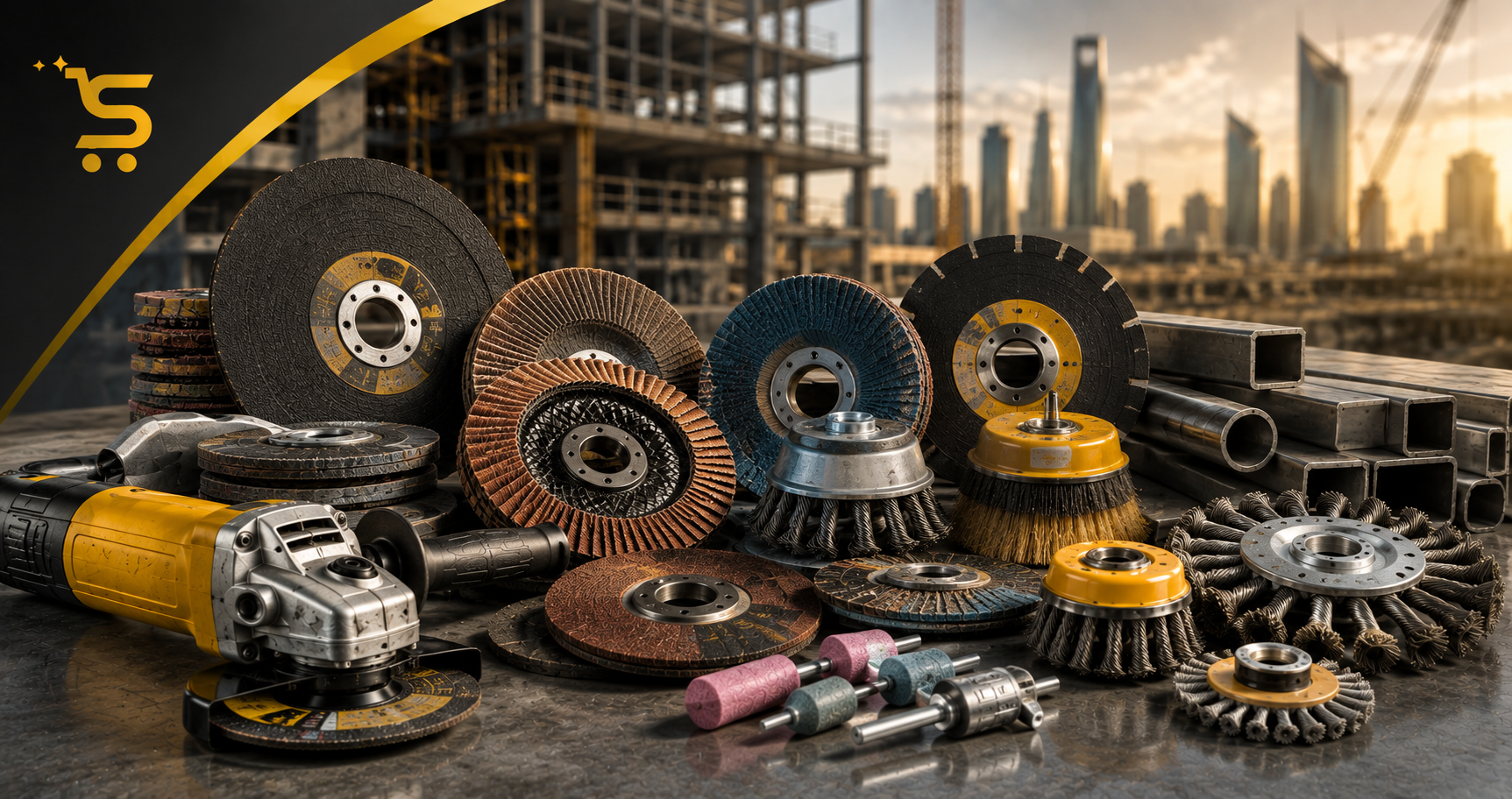
Abrasive tools play a vital role in metal fabrication, construction, maintenance, and industrial work. Cutting discs, grinding wheels, flap discs, sanding products, wire brushes, and diamond blades each serve different purposes, and choosing the right product can make a significant difference in productivity, surface quality, operating cost, and workplace safety.
The best selection starts with the material and application. From there, businesses should verify abrasive type, grit, dimensions, machine compatibility, operating speed, and manufacturer requirements.
For contractors and industrial businesses in Saudi Arabia, a well-planned abrasive-tool procurement strategy can help teams work more efficiently while maintaining appropriate safety standards. Quality tools, correct application, proper inspection, and trained operators should always work together.
Frequently Asked Questions
1. What are the best abrasive tools for metal work?
Common options include cutting discs, grinding wheels, flap discs, sanding discs, wire wheels, and mounted points. The best choice depends on the metal, required operation, machine, and desired surface finish.
2. Which abrasive tool is best for cutting steel?
A suitable metal cutting disc is commonly used for steel. The disc should be specifically rated for the material and compatible with the grinder or cutting machine, including its diameter and maximum operating speed.
3. Can a cutting disc be used for grinding?
No. Cutting discs are designed for cutting operations and should not be used as general grinding wheels. Always use an abrasive product designed for the specific operation.
4. What abrasive tool is best for concrete?
Diamond cutting blades are commonly used for concrete and other hard construction materials. The appropriate blade should be selected according to the material, machine, and cutting application.
5. How do I choose the correct abrasive grit?
Choose grit according to the required level of material removal and finish. Coarser grits are generally used for faster stock removal, while finer grits are better suited to finishing and smoothing.
6. What PPE is needed when using abrasive tools?
Depending on the task and risk assessment, workers may need eye protection, face protection, hearing protection, gloves, safety footwear, protective clothing, and suitable respiratory protection.
7. How should abrasive discs be stored?
Abrasive products should be stored according to manufacturer instructions in a suitable location protected from damaging environmental conditions, impact, contamination, and excessive moisture. Products should be handled carefully to prevent damage.
Contact Saudi Supplier
Phone: +966565118011
Email: info@saudisupplier.com
Website: Saudi Supplier
