







































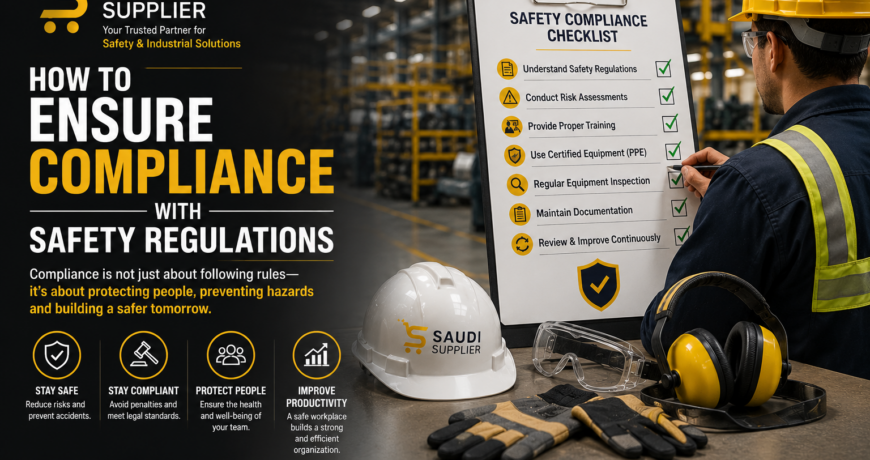
How to Ensure Compliance with Safety Regulations
Workplace safety compliance is a fundamental responsibility for businesses operating in construction, manufacturing, warehousing, maintenance, logistics, and other industrial environments. In Saudi Arabia, organizations must take workplace hazards seriously and establish systems that protect employees, contractors, visitors, equipment, and operations.
Safety compliance is not simply about purchasing helmets, safety shoes, warning signs, or protective equipment. Effective compliance requires a complete safety management approach that combines risk assessment, employee training, appropriate equipment, inspections, documentation, emergency planning, and continuous improvement.
For industrial companies and contractors, a strong compliance program can also reduce workplace incidents, equipment damage, operational disruption, and unnecessary costs.

What Does Workplace Safety Compliance Mean?
Workplace safety compliance means establishing and maintaining working conditions that meet applicable occupational safety requirements, industry standards, company procedures, and other legal or contractual obligations.
Depending on the nature of the business, compliance may involve areas such as:
- Personal protective equipment (PPE)
- Machinery and equipment safety
- Electrical safety
- Fire prevention and emergency response
- Working at height
- Hazardous materials
- Chemical handling
- Construction-site safety
- Manual handling
- Workplace signage
- Employee training
- Equipment inspection and maintenance
- Incident reporting
The exact requirements depend on the activity, workplace, equipment, workforce, and applicable Saudi regulations and standards. Therefore, businesses should verify requirements with the relevant Saudi authorities and qualified safety professionals rather than relying on generic checklists.
Businesses can source industrial and workplace products through Saudi Supplier.
Why Safety Compliance Matters for Saudi Businesses
Safety compliance should be viewed as an operational priority rather than an administrative task.
A well-managed safety program can help businesses:
- Protect employees and contractors
- Reduce workplace hazards
- Minimize accidents and injuries
- Improve operational reliability
- Reduce equipment damage
- Support productivity
- Strengthen employee confidence
- Improve contractor management
- Demonstrate responsible business practices
- Reduce the risk of regulatory problems
For construction companies and industrial facilities, even a relatively small incident can result in downtime, investigation, equipment damage, project delays, and financial losses.
Safety Compliance Is an Ongoing Process
A workplace does not become permanently compliant after one inspection.
Processes, machinery, employees, contractors, materials, and working conditions change over time. Consequently, safety programs should be reviewed regularly.
1. Identify the Safety Requirements That Apply to Your Business
The first step is understanding which regulations, standards, and requirements apply to your operation.
A construction site, warehouse, manufacturing plant, and office environment will not have identical safety requirements.
Start by identifying:
- The type of business activity.
- Workplace hazards.
- Machinery and equipment in use.
- Chemicals or hazardous materials present.
- Work-at-height activities.
- Electrical systems.
- Fire and emergency risks.
- Contractor and visitor activities.
- Required PPE.
- Applicable regulatory and industry requirements.
Companies should maintain an updated compliance register showing the requirements relevant to their operations.
2. Conduct a Comprehensive Risk Assessment
Risk assessment is one of the most important elements of workplace safety.
A practical assessment should identify:
Hazard → Who may be exposed → Likelihood → Potential consequence → Controls
Common industrial hazards include:
- Falling objects
- Moving machinery
- Electrical hazards
- Slips and trips
- Excessive noise
- Dust and airborne particles
- Chemicals
- Heat
- Fire
- Working at height
- Vehicle movement
- Manual handling
- Poor housekeeping
The assessment should not simply identify hazards. It should also determine how each hazard will be controlled.
Use the Hierarchy of Controls
Whenever possible, organizations should prioritize controls according to established risk-control principles.
These generally include:
- Elimination
- Substitution
- Engineering controls
- Administrative controls
- Personal protective equipment
PPE is important, but it should not automatically be the first or only control.
For example, if a machine presents a moving-part hazard, installing an appropriate guard may provide a stronger control than relying solely on workers wearing gloves.
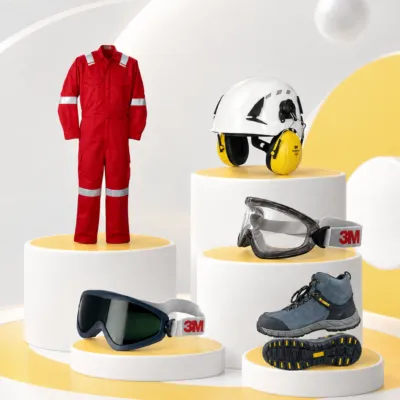
3. Provide Appropriate Personal Protective Equipment
When PPE is required, employers should ensure that workers receive equipment appropriate to the identified hazards.
Depending on the workplace, PPE may include:
- Safety helmets
- Safety glasses
- Face shields
- Safety footwear
- Protective gloves
- Hearing protection
- Respiratory protection
- High-visibility clothing
- Fall-arrest equipment
- Protective clothing
Saudi Supplier provides access to Safety Equipment and PPE products for businesses looking for workplace protection solutions.
PPE Must Fit the Job
Choosing PPE based only on price is not a good procurement strategy.
Consider:
- Hazard type
- Required protection level
- Fit
- Comfort
- Compatibility with other PPE
- Work environment
- Expected usage
- Maintenance requirements
- Applicable standards
For example, workers using power tools may need eye and hearing protection, while workers performing elevated construction work may require suitable fall-protection equipment.
4. Train Employees Before They Perform Hazardous Work
Equipment cannot replace proper training.
Workers should understand:
- Workplace hazards
- Safe operating procedures
- PPE requirements
- Emergency procedures
- Equipment limitations
- Reporting procedures
- Inspection requirements
- Restricted areas
- Safe material-handling practices
Training should be relevant to the employee’s actual responsibilities.
For example, an employee operating industrial machinery requires different training from a warehouse worker operating around forklifts.
Refresh Training Regularly
Training should also be refreshed when:
- New equipment is introduced
- Work procedures change
- A new hazard is identified
- An incident occurs
- An employee changes responsibilities
- Regulations or company requirements change
Keep records showing who received training, when it occurred, what was covered, and whether additional action is required.
5. Inspect and Maintain Industrial Equipment
Equipment condition directly affects workplace safety.
Businesses should establish inspection and maintenance schedules for relevant equipment.
Depending on the equipment, inspections may cover:
- Power tools
- Electrical equipment
- Ladders
- Scaffolding
- Lifting equipment
- Compressors
- Generators
- Machinery guards
- Cables and connections
- Hand tools
- Fall-protection equipment
Companies can also review industrial tools and related workplace supplies when establishing appropriate equipment inventories.
Remove Defective Equipment From Service
If equipment is damaged or unsafe, employees should not continue using it simply because the job is urgent.
A practical process is:
Identify → Tag → Isolate → Repair or replace → Inspect → Return to service
This prevents defective equipment from accidentally being returned to active use.
6. Maintain Clear Safety Signs and Instructions
Safety signs provide visual communication where workers and visitors need immediate information.
Depending on the workplace, signs may communicate:
- Mandatory PPE
- Fire equipment locations
- Emergency exits
- Restricted areas
- Electrical hazards
- Chemical hazards
- Falling-object risks
- Forklift routes
- No-smoking areas
- First-aid locations
- Warning and prohibition information
Signs should be visible, understandable, correctly positioned, and maintained in good condition.
They should complement—not replace—proper training and physical safety controls.
7. Establish Emergency Response Procedures
Every workplace should be prepared for foreseeable emergencies.
An emergency plan may address:
- Fire
- Medical emergencies
- Chemical spills
- Electrical incidents
- Equipment failures
- Severe weather
- Evacuation
- Other site-specific emergencies
Employees should know:
- How to raise an alarm
- Where to evacuate
- Where assembly points are located
- Who has emergency responsibilities
- Where first-aid resources are located
- How emergency equipment should be used
Emergency procedures should be practiced periodically so employees know what to do under pressure.
8. Control Contractor and Visitor Safety
Contractors can introduce additional risks because they may be unfamiliar with the site’s procedures.
Before work begins, businesses should establish a contractor-management process covering:
- Site induction
- Competency verification
- Required PPE
- Work permits where applicable
- Risk assessments
- Method statements where appropriate
- Equipment requirements
- Emergency procedures
- Site rules
- Supervision
Visitors should also receive appropriate safety instructions and access only to permitted areas.
9. Keep Accurate Safety Documentation
Documentation provides evidence that safety processes are actually being implemented.
Important records may include:
- Risk assessments
- Inspection checklists
- Training records
- Equipment maintenance records
- PPE distribution records
- Incident reports
- Corrective actions
- Emergency drills
- Contractor induction records
- Safety meeting records
Good documentation also makes it easier for management to identify recurring problems.
Use Digital Records Where Practical
Businesses with multiple sites can benefit from digital safety records.
Digital systems can help teams track:
- Inspection due dates
- Training expiry dates
- Equipment maintenance
- Corrective actions
- Incident trends
- Outstanding safety tasks
The important objective is not whether records are digital or paper-based. The objective is that they are accurate, accessible, current, and properly controlled.
10. Report and Investigate Incidents
A strong safety culture encourages employees to report hazards, near misses, and incidents.
A near miss is particularly valuable because it can reveal a dangerous condition before someone is injured.
When an incident occurs, businesses should focus on identifying underlying causes rather than simply blaming an individual.
Ask:
- What happened?
- Where did it happen?
- What conditions existed?
- What procedures were in place?
- Was training adequate?
- Was equipment suitable?
- Were controls implemented?
- What could prevent recurrence?
Corrective actions should then be assigned, tracked, and verified.
Safety Compliance Checklist for Industrial Workplaces
| Area | Key Action |
|---|---|
| Risk assessment | Identify and evaluate workplace hazards |
| PPE | Provide appropriate protective equipment |
| Training | Train workers for their specific duties |
| Equipment | Inspect, maintain, and repair equipment |
| Signage | Display appropriate safety information |
| Emergency planning | Establish and practice response procedures |
| Contractors | Verify competency and provide site induction |
| Documentation | Maintain accurate safety records |
| Incident management | Report, investigate, and correct problems |
| Review | Regularly evaluate safety performance |
Common Safety Compliance Mistakes to Avoid
Treating PPE as the Only Safety Control
PPE is essential in many workplaces, but stronger controls should be considered where feasible.
Using Damaged Equipment
A cracked ladder, damaged cable, defective tool, or worn PPE should not remain in service.
Providing Training Only Once
Employees need continuing awareness, especially when work conditions change.
Ignoring Near Misses
Near misses can reveal hazards before they result in serious incidents.
Purchasing Equipment Without Checking Specifications
A product must be appropriate for the intended task and environment.
Failing to Monitor Contractors
Contractor safety should be integrated into the site’s overall safety-management process.
How Procurement Supports Safety Compliance
Procurement teams have an important role in workplace safety.
Purchasing decisions should consider more than price. Before ordering safety-critical products, verify:
- Product specifications
- Intended application
- Quality
- Applicable standards
- Manufacturer information
- Product authenticity
- Warranty where relevant
- Availability of replacement parts
- Supplier reliability
Businesses can also review construction materials when planning construction and site requirements.
For organizations purchasing large quantities, establishing approved-product lists can help standardize equipment across departments and worksites.
Build a Safety Culture, Not Just a Compliance Checklist
Regulations and checklists are important, but effective workplace safety depends on employee behavior and management commitment.
A strong safety culture encourages workers to:
- Report hazards
- Stop unsafe work
- Use PPE correctly
- Follow procedures
- Maintain equipment
- Ask questions
- Participate in safety training
- Learn from incidents
Management should demonstrate the same commitment. When supervisors consistently prioritize safe working practices, employees are more likely to treat safety as part of their normal responsibilities.
Conclusion
Ensuring compliance with safety regulations requires a systematic approach. Businesses should understand the requirements that apply to their operations, assess hazards, implement appropriate controls, provide suitable PPE, train employees, maintain equipment, document safety activities, and regularly review performance.
For companies operating in Saudi Arabia, safety compliance should be integrated into everyday operations rather than treated as a one-time inspection exercise.
The most effective strategy is to combine regulatory awareness, risk management, quality equipment, employee training, preventive maintenance, emergency planning, and continuous improvement.
By making safety part of procurement, project planning, supervision, and daily work practices, industrial and commercial organizations can create safer workplaces while supporting operational efficiency and long-term business performance.
Frequently Asked Questions
1. How can a company ensure workplace safety compliance?
A company should identify applicable requirements, conduct risk assessments, implement appropriate controls, provide suitable PPE, train employees, inspect equipment, maintain documentation, and regularly review its safety program.
2. Why is risk assessment important for safety compliance?
Risk assessment helps organizations identify hazards, determine who may be exposed, evaluate potential consequences, and select appropriate controls before incidents occur.
3. What PPE is required in industrial workplaces?
PPE depends on the hazards present. Common examples include safety helmets, protective footwear, gloves, eye protection, hearing protection, respiratory protection, high-visibility clothing, and fall-protection equipment.
4. How often should workplace safety training be conducted?
Training should be provided before employees perform relevant hazardous work and refreshed when equipment, procedures, responsibilities, hazards, or applicable requirements change. Organizations should also conduct periodic refresher training based on their risk profile.
5. Why should industrial equipment be inspected regularly?
Regular inspections can identify damage, wear, defects, or unsafe conditions before equipment is used. Defective equipment should be removed from service until it has been appropriately repaired or replaced.
6. What safety documents should businesses maintain?
Depending on the operation, records may include risk assessments, training records, inspection reports, maintenance records, PPE records, incident reports, corrective actions, emergency drills, and contractor induction records.
7. How can contractors comply with workplace safety requirements?
Contractors should understand site rules, complete required inductions, provide competent workers, use appropriate PPE, follow approved procedures, participate in risk assessments where required, and comply with the site’s emergency and reporting processes.
8. Can buying quality safety equipment improve compliance?
Quality safety equipment can support a company’s safety program when products are correctly selected, maintained, and used. However, equipment alone does not establish compliance; it must be combined with risk controls, training, inspections, and appropriate procedures.
Contact Saudi Supplier
Phone: +966565118011
Email: info@saudisupplier.com
Website: Saudi Supplier
